Using Social Media Amplification for Organic Content
Your reach on organic content isn’t as good as you might think. You can create the perfect post and publish it only to find out that there’s silence in response. Social media amplification will help you amplify that organic content.
Table of content
Using Social Media Amplification to Enhance Your Organic Posts
What Exactly Is Paid Social Media Amplification?
Selecting the Correct Content To Be Promoted
Budget Allocation That Makes Sense for Most Brands
Linking Ad Campaign Objectives to Your Strategy Goals
Finding the Right Audience is The Key to Success
Advantages and Disadvantages of Paid Amplification
Mistakes to Avoid While Amplifying Organic Content
Best Practices for Popular Social Media Platforms
5 Tools You Can Try for Paid Social Amplification
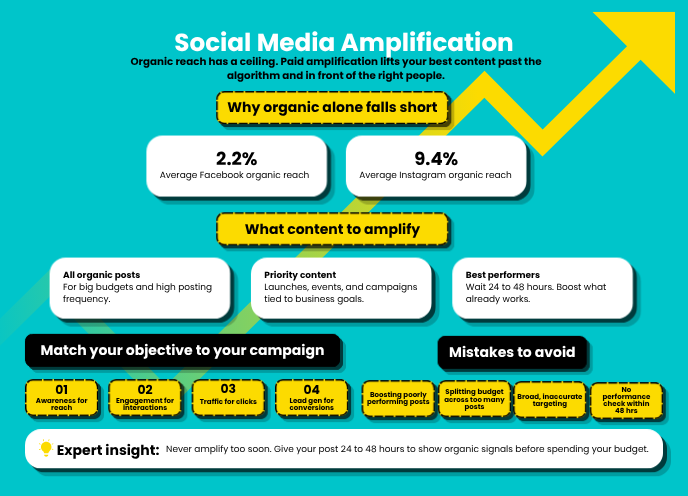
In actuality, organic reach has limits. Facebook posts reach only 2.2% of followers, whereas Instagram reaches a mere 9.4%. This way, even the most loyal members of your audience may fail to see your best content. Paid social is the key to avoiding being hidden away by algorithms.
Here comes the exciting part: paid social works best when used to amplify organic social posts, rather than replacing them entirely. When you pay to spread content that works for you already, you don't need to guess about successjust repeat what worked once before.
What Exactly Is Paid Social Media Amplification?
To begin with, social media amplification involves promoting organic posts by utilizing the power of paid advertisements.
Rather than coming up with brand new ads, we will be promoting our best-performing posts – those which have already generated a lot of traction organically. This tactic is cost-effective, backed by statistics, and much safer compared to creating something from scratch.
For instance, statistics show that videos attract 38% more engagement compared to static posts. Thus, there is no doubt that it will do good to amplify any post if its organic performance is strong enough.
Selecting the Correct Content To Be Promoted
When it comes to social media amplification, there are certain pieces of content which require more effort to be made.
It is critical to understand which type of content needs to be promoted and when. Here we provide three possible strategies:
1. All Organic Posts
Most suitable for brands with big budgets and frequent postings. It maintains consistency but may reduce effectiveness.
2. Priority Content
Consider focusing on product launches, campaigns, events, or promotions. This is an effective strategy to match expenses with business objectives.
3. Best Performing Posts
Allow the audience to dictate. After 24–48 hours, choose the posts that exceed engagement thresholds.
Remember to ensure a minimum share rate of 2%.
Budget Allocation That Makes Sense for Most Brands
It makes no sense to toss money at ads haphazardly. A budget allocation strategy is what distinguishes the professional from the amateur.
Prioritizing Channels
If Facebook generates more leads, allocate roughly 60% to it and the rest to Instagram.
Frequency of Postings
More postings in one medium mean that it needs more of the budget.
By Marketing Objective
Lead generation campaigns need more budgeting than awareness campaigns.
Smart budget allocation will ensure that your paid social media strategy remains on track.
Linking Ad Campaign Objectives to Your Strategy Goals
Every ad campaign must have its objective. This is how to link them:
Maximizing Reach:
Awareness ad campaigns optimized for reach.
Increasing Engagement:
Engagement campaigns designed to generate interactions.
Driving Traffic:
Traffic ad campaigns optimized for clicks.
Generating Leads:
Lead generation campaigns with forms.
Finding the Right Audience is The Key to Success
Great content goes to waste if shared with the wrong people. A good social media marketing company would know what to do. Some effective targeting strategies they adopt are:
Following Targeting: Leverage your followers’ potential.
Lookalike Audiences: Find users who share similarities with your audience (often reduces cost by around 20%).
Interest and Behavior Targeting: Utilize interest-based targeting and behavior-based targeting
This is where social media amplification works magic—highly-targeted at large scale.
Advantages and Disadvantages of Paid Amplification
Advantages:
Significant increase in reach and impressions
High engagement rates
Superior targeting abilities
Disadvantages:
Necessitates financial investments
Potential for wasting money on poor content
Regular tracking required
Mistakes to Avoid While Amplifying Organic Content
Even veteran marketers make mistakes. Here’s what to avoid:
Dividing budget among too many posts
Boosting poorly-performing content without proper assessment
Generalized and inaccurate targeting
Failing to analyze performance metrics within 48 hours
Avoid these pitfalls, and your organic content amplification will drastically improve.
Best Practices for Popular Social Media Platforms
Good for varied types of ads (carousels, videos, collections)
Good for precise targeting
Best for visual marketing (Reels, Stories)
Better organics
Typically both require $5-$10 a day in budgets. Makes them affordable to use even for small businesses. You can consult Buzzion for further guidance!
5 Tools You Can Try for Paid Social Amplification
Facebook Ads Manager
Sprout Social
Hootsuite Ads
Buffer Ads
Socialbakers
This makes the process easier to manage and track and optimize.
How to Gauge the Performance of Your Organic Content?
The numbers won’t lie. Pay attention to them:
Reach Versus Follower Growth
CPM (Cost per Mille): Target around $5-$8
Engagement Rate = (Engagement/Impressions) * 100
Cost Per Result = Spending/conversions
Weekly reports should become your new routine, changing creatives, target audiences and increasing your bidding as needed. This is the kind of strategy that converts.
Conclusion
The power of social media amplification comes from the harmony between these two strategies. You should neither choose one over the other. Consider using both to create synergy.
Organic content brings credibility and engagement. Paid social brings reach. The proper use of these strategies can generate momentum that is impossible to create independently.