
2016 to 2026: How Has SEO Changed Over the Last 10 Years?
SEO was a completely different animal in 2016. Companies targeted exact match terms. Some sites with only very thin blog or web content could easily rank quickly. Backlinks were considered to be an easy way for websites to gain an advantage over their competition. Many businesses would search the internet for guides on how to market their business. So, how has SEO changed over the decade?
key takeaways
- SEO has transitioned from focusing on keywords to focusing on understanding user intent.
- AI answers will change how people interact with their search results.
- User experience now has a direct relation on ranking and visibility.
- The use of thin content and spam techniques will not be effective in 2016.
- Brand authority is now a key competitive advantage in the world of SEO.
- Unique insights and human expertise will be more important than ever before.
The game has changed considerably today. Search engine algorithms now take into account many different things. AI systems now “know” the answers to a question before the user even clicks the search link to get to the page. The way that the search engines evaluate a web page (the quality of the website) is now based on several factors.
SEO is now about the people that are using search engines. The behaviour of users now drives the rankings/relevance of a website more than technical tricks have ever done. Old business who are not updated with modern SEO are often shocked to learn that old tactics for ranking that used to work now actually hurt their SEO performance.
Are you ready to maintain your rankings?
The latest successful search engine optimization strategies can reshape your brand. Contact Buzzion today to build lasting search visibility.
From Keywords to Intent: The Primary Evolution
Marketers created separate web pages in 2016 to pursue the various keywords around “SEO Tools”. Marketers now use three separate pages – “Best SEO Tools”, “Top SEO Tools”, and “SEO Tools Best” – all to rank for different variations of the same search term. These strategies worked well due to the fact that search engines in 2016 were using primarily keyword-based matching.
Fast forward to today. Search engines have improved their ability to understand user intent and match users to the best content. One well-written and well-researched web page can rank for hundreds of different variations of related search terms as long as that page provides the best answers to the question.
This is one of the greatest examples of how the field of search engine optimization has changed. We have moved from focusing on keywords to focusing on establishing authority on a given topic.
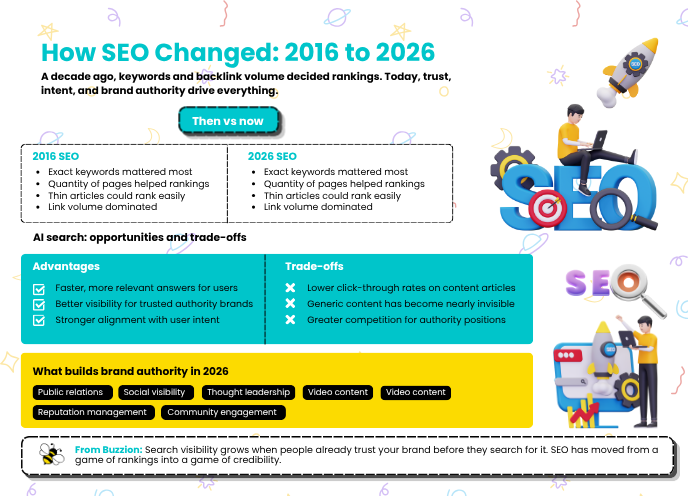
Then vs Now
2016 SEO | 2026 SEO |
Exact keywords mattered most | Search intent matters most |
Quantity of pages helped rankings | Depth and usefulness help rankings |
Thin articles could rank | Comprehensive content wins |
Link volume dominated | Trust and authority dominate |
How Has AI-Driven Search Changed SEO?
Not one algorithm has transformed how SEO works. The metamorphosis of how search is conducted and subsequently how a user interacts with a website has transformed because artificial intelligence generates responses within a search engine.
Consumers can receive summaries of what they are about to find on a website before ever clicking on it. As a by-product, searches that provided information with an instant answer do not transfer visitors to websites anymore.
Brands are focusing more on original data and user experience and also original expertise with empirical data, insight, and interactive applications to provide the user with something different, in addition to the new multimedia information available from sources such as Google Assistant.
Benefits and Negatives
Advantages:
- Faster responses to users
- Better understanding of search intent
- Increased visibility for a trusted authority
Disadvantages:
- Lower CTR on content-based articles
- Greater competition for authority
- General information has become more invisible.
expert tip
“The smartest brands understand that search visibility grows when people already trust the business before searching.”

Daniel Carter
SEO Strategy Expert
Why Brand Authority is More Important Than Ever?
Unknown websites could rank higher in the SERPs than large corporations overnight. It is happening less frequently. Search engines continue to favour established brands within a specific sector that have perishable reputations. Therefore, if an organization receives multiple mentions on the Internet for a given state, it will positively affect the organization’s reputation.
SEO is becoming more integrated into the marketing mix than ever before. We can track whether or not a brand’s marketing strategy will directly affect its SEO rank:
- Public relations
- Social visibility
- Thought leadership
- Video
- Community engagement
- Reputation management
Looking for SEO strategies?
Find the ones developed for the next decade rather than the last decade. Visit Buzzion and learn how modern search engine optimization can lead to continued growth.
Conclusion
How has SEO changed in a decade? Dramatically. The one-word answer that fits. The industry moved away from technical manipulation towards user experiences. Search engines have become more intelligent. The AI revolutionized the delivery method of information. Trust has become more important than trickery. SEO has transitioned from a game of rankings into a game of credibility.
faq
why did seo strategies that worked in 2016 stop working today?
SEO strategies that worked in the past no longer work today because search engines have improved their ability to identify manipulation.
what are the biggest seo ranking changes google made in the last 10 years?
The biggest changes include mobile indexing. AI-powered search understanding. Core Web Vitals. Helpful content systems. Spam prevention updates. And a stronger focus on expertise and trust.
how is seo in 2026 different from traditional seo in 2016–2020?
SEO in 2026 focuses more on authority. User experience. AI visibility. Brand trust. And topical expertise. Traditional SEO focused more on technical optimization and keyword targeting.
how do ai answers choose which websites to show?
AI systems prioritize trustworthy sources with a clear structure. Strong expertise. Accurate information. And high relevance to the search query. Well-organized content improves visibility.
what is the latest update in seo that businesses should care about most?
The primary way businesses should be concerned about SEO today is that there is now an AI search experience occurring within search engines. That requires businesses to optimize their content both for users.