
Customer Life Cycle Definition Explained for Modern Brands
- key takeaways
- Make your customer journey more effective!
- What Is the Customer Lifecycle Definition? All 6 Stages You Should Know!
- Stage 1: Awareness
- Stage 2: Consideration
- Stage 3: Conversion
- Stage 4: Retention
- Stage 5: Loyalty
- expert tip
- Daniel Brooks
- Stage 6: Advocacy
- Do not worry about retention anymore!
- Conclusion
- faq
Consumers have developed an intricate buying behavior today. People do not move directly from advertising to making purchases. Consumers browse online. They make comparisons. They read reviews. They subscribe to companies on various platforms. The consumers leave and revisit sites later. These reasons make it imperative to learn the customer life cycle definition.
key takeaways
- The customer lifecycle captures all aspects of the journey from awareness to advocacy.
- Each phase necessitates unique marketing strategies and modes of communication.
- Retention and loyalty yield higher returns than continuous customer acquisition.
- Personalization enhances all phases of the marketing customer lifecycle.
- Customer advocacy can transform into the most powerful form of marketing.
- Companies that recognize the customer engagement lifecycle experience better growth.
The customer lifecycle enables brands to comprehend all interactions customers make during their purchasing process. It provides insight into how a person discovers a brand. In addition, customers learn how individuals turn into brand loyalists. Companies benefit from this information by enhancing customer experience and maximizing income.
Companies like Buzzion consider the customer lifecycle when planning their business strategies. The customer engagement lifecycle becomes a key consideration in developing successful marketing plans. Companies that learn about the marketing customer lifecycle can design campaigns that maximize retention and loyalty.
Make your customer journey more effective!
Our team at Buzzion works to help brands develop marketing strategies aimed at engaging customers.
What Is the Customer Lifecycle Definition? All 6 Stages You Should Know!
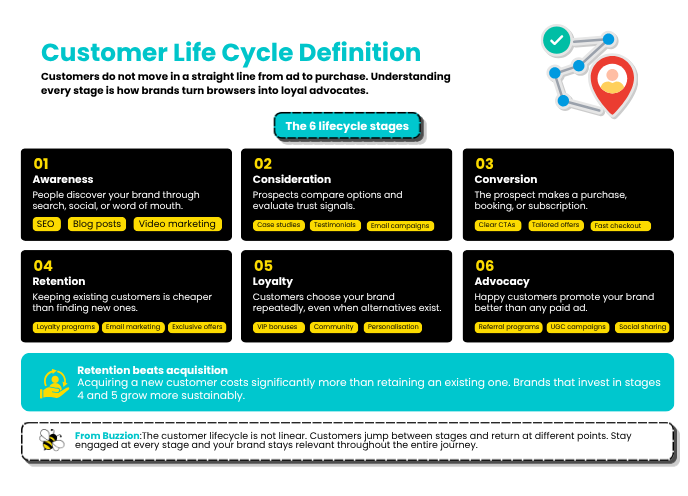
The customer lifecycle definition entails the process a customer undertakes. Starting from discovering a brand up to turning into its long-term advocate. Each step indicates varying levels of interactions between customers and brands.
Customer lifecycle stages enable marketers to know what customers expect at particular periods. An initial stage of contact with a brand requires educational processes. Loyal clients demand rewards and recognition.
Most firms miss chances when they fail to distinguish between individual customers. However, this challenge can be solved via the customer lifecycle approach because it enables the firm to market in the appropriate manner.
Stage 1: Awareness
The awareness stage forms the beginning of the marketing lifecycle stages. People become aware that there is a brand.
Customers can become aware of a certain business via their social media platforms. Awareness can also occur through an informative blog post found on Google. Friends of the customers might inform them about the business too.
During this stage, clients are still exploring their options. They are simply gathering knowledge about what they will get once they visit the website.
The business should be able to do the following:
- Creating educational posts on blogs
- Visibility on social media sites
- Effective SEO tactics
- Video marketing campaigns
- Innovative brand story telling
Stage 2: Consideration
When customers enter the consideration phase, they start looking for solutions to their problems by analyzing different alternatives. Here comes the role of trust. Customers analyze the products and services carefully and pay much attention to the available testimonials.
In order to be successful during this phase, businesses should provide valuable information. Tactics for consideration phases include:
- Product comparison
- Email campaigns
- Case studies
- Testimonials
- Free resources
Stage 3: Conversion
Conversion is the phase when a potential client finally decides to purchase a product. This is considered to be the most interesting phase within the entire lifecycle.
A conversion may mean purchasing an item or subscribing to something. Sometimes it means booking a consultation, depending on the business model. Companies often think only about the conversion phase, neglecting the fact that the customer lifecycle includes more phases than just the sales.
Businesses should pay attention to:
- User-friendly checkout processes
- Reasonable pricing
- Compelling calls to action
- Quick website loading
- Tailored offers
Stage 4: Retention
Retaining clients leads to sustainable development. The cost of obtaining a new customer exceeds the expense of retaining an existing client. If a person already believes in the brand, he will be ready to purchase from it again. That is why retention is among the crucial phases of the customer lifecycle.
Businesses must provide value even after the sale. The retention strategies include:
- Email marketing
- Loyalty programs
- Top-notch customer service
- Exclusive offers
- Customized product recommendations
A firm that retains clients ensures stable income and enhances brand stability.
Stage 5: Loyalty
The loyalty stage entails clients’ continuous purchases. They believe in the brand and prefer it over its competitors, even if there are changes in prices. Loyalty is gained through persistence. People become loyal when businesses continuously meet their demands.
The marketing customer lifecycle loyalty phase is significant since loyal clients spend more money on purchases. Methods to reinforce loyalty include:
- VIP bonuses
- Personalized contact
- Creation of community
- Prioritized access to goods
- Unwavering quality
Loyalty turns clients into valuable business assets.
expert tip
“Avoid viewing the customer lifecycle as a linear process. Customers do not follow the same path throughout the lifecycle in contemporary times. Engagement will help you stay relevant throughout the entire customer journey.”

Daniel Brooks
Digital Marketing Expert & PPC Strategist
Stage 6: Advocacy
Advocacy is the last stage of the customer lifecycle. This is when the client promotes the brand among other consumers. They write positive reviews. They refer the company to their peers. They post products on social media. Advocates are crucial since recommendations from consumers tend to be trusted more than ads.
To facilitate advocacy, brands can use:
- Referral programs
- Engagement on social media
- Campaigns to honor loyal customers
- Creation of user-generated content
- Remarkable experiences for clients
An advocate turns into an independent marketing medium.
Do not worry about retention anymore!
Buzzion assists companies in enhancing customer retention by implementing efficient content strategies and engagement systems aimed at sustainable development.
Conclusion
Customer lifecycle goes beyond being a marketing concept. It becomes an opportunity for organizations to know their customers more. Those companies that understand well the steps of customer lifecycle experience more success because they build deeper relationships. Buzzion has realized that marketing must be about relationships in the coming years.
faq
what is the customer lifecycle in digital marketing?
The customer lifecycle in digital marketing is the process customers go through from discovering a brand to becoming loyal advocates.
how does the customer lifecycle work step by step?
The lifecycle begins with awareness. Customers then move into consideration and conversion. Businesses then focus on retention and loyalty and advocacy to maintain relationships.
why is the customer lifecycle important for marketing?
The customer lifecycle helps businesses understand customer behaviour at every stage. This allows marketers to create better campaigns and improve engagement and increase revenue.
how can businesses optimize each stage of the customer lifecycle?
Businesses can optimize each stage through personalized communication, strong customer support, useful content, loyalty programs and marketing strategies.
what are the main stages of the customer lifecycle?
Awareness. Consideration. Conversion. Retention. Loyalty. Advocacy. Each stage represents a different relationship between the customer and the brand.